Shapes before things
This area trains his core habit: design the light and dark shapes first, then fit the people and places inside them.
Mateu-Mestre · FI1 p.34“think in terms of basic, clear, and readable shapes”
Value template → two scenes
Make one black and white template for a mood, then fit two unrelated settings into it.
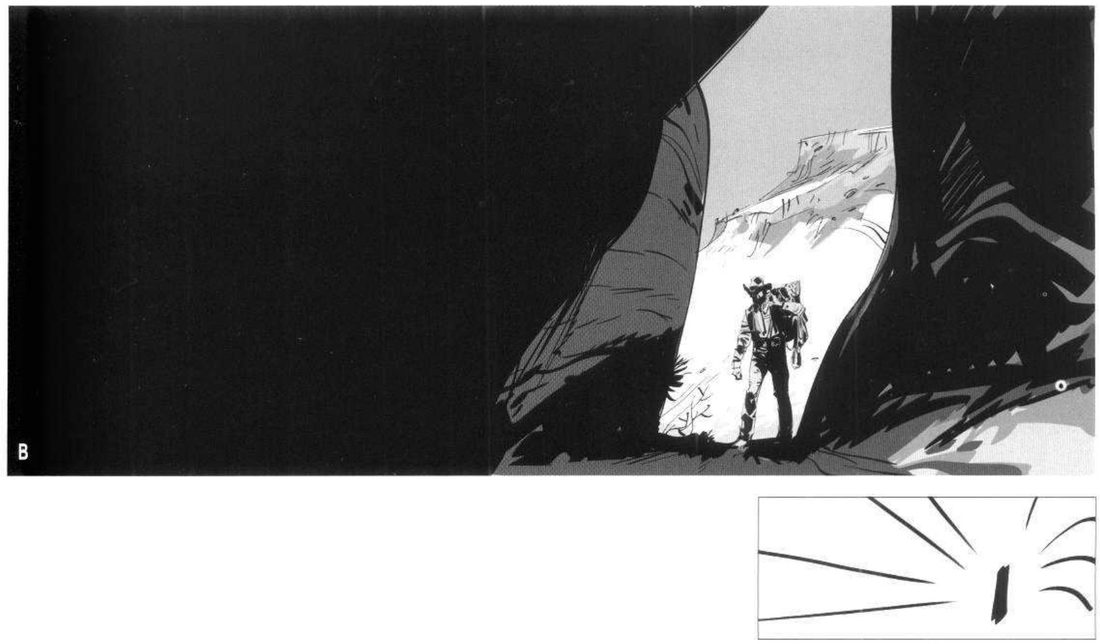
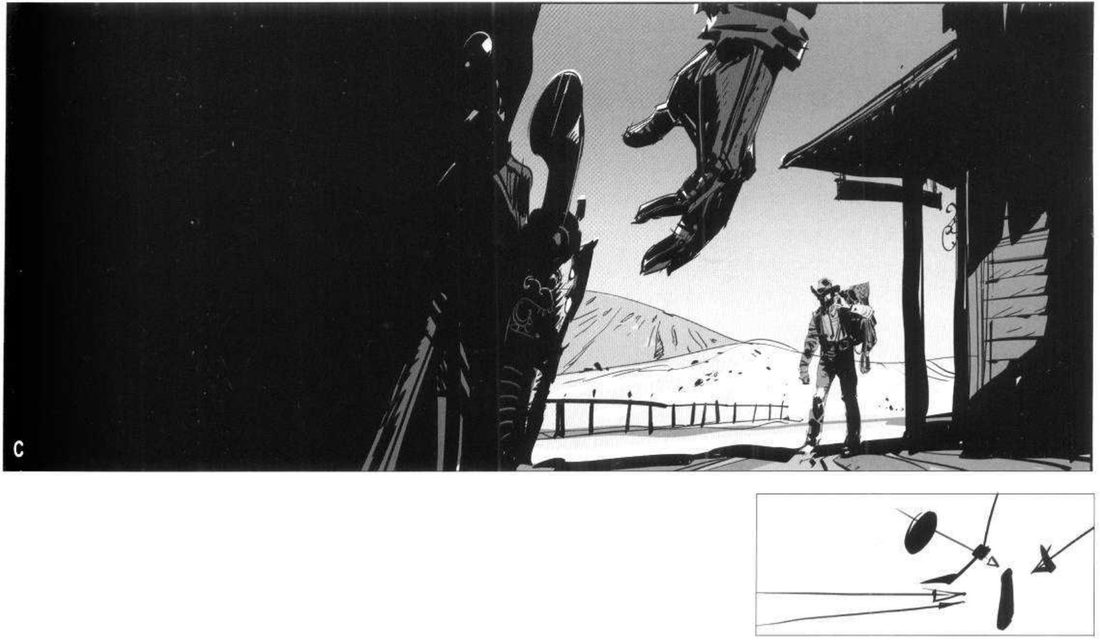
FI1 p.34–35 · template A (p.34), examples B and C (p.35)
What he shows
He opens chapter 3 with this as the process the chapter illustrates. Don't start from the elements (characters, furniture, rocks, trees). Start from basic, readable shapes, then compose the elements inside them.
His demo goal is an oppressive environment, a composition that strangles the character visually. For that he makes template A: a black frame with one tilted white shape on the right.
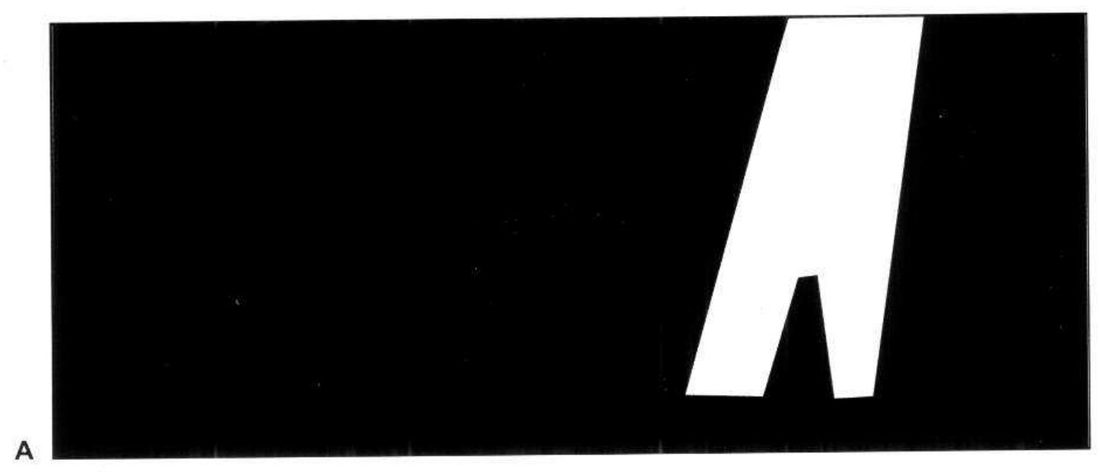
Then he commits to it. He calls it suffocating, claustrophobic and dramatic, and says it sends the eye clearly to the main area of focus, so the choice is successful. From there, the job is to draw and light the image following the template. The story’s situation has to fit the template.
Mateu-Mestre · FI1 p.34“stick to it and use it as a clear visual statement”
Mateu-Mestre · FI1 p.34“The specific situation that the story dictates will have to conform to this”
On p.35 he adds the second half of the method. Each finished scene gets a line thumbnail showing its dynamics, physical lines and perceived ones, connecting the dots (he points back to p.26). B and C get only the line thumbnail, because A is their shared mass thumbnail.
His cowboy is the demo. The method is any mood, any setting.
His version: open after you've done yours
When you practise
Read once · his steps from p.34–35, numbered by me
- Write the one-line intent: what should this frame make you feel? His was oppressive, a frame that strangles the character.
- Make the template. Light and dark masses only, black and white, no objects.
- Test it before you draw anything in it: does it give the feeling, and does it send the eye to one place?
- Commit. From here the template doesn’t change.
- Pick a setting. Draw and light it following the template. Bend the setting until it fits.
- Make its line thumbnail: physical lines (edges, fences, shadows) and connect-the-dots lines (pistol butt to knuckles to head). Where do they point?
- Pick a second setting that shares nothing with the first. Repeat steps 5 and 6 with the same template.
Checkhis test for A: it feels suffocating, claustrophobic and dramatic, and it directs the eye clearly to the main area of focus (FI1 p.34, close paraphrase). Use your own mood words in place of his. Then shrink and flip both scenes, and compare them with his B and C.
Value template
Mood → template → commit → two settings that obey it.
Keep asking: does it send the eye clearly to the main focus?
Reverse-engineer his thumbnails
Reduce his finished frames to his two thumbnails yourself, then check against the ones he printed.
FI1 ch.3 (p.34–35 for the system, p.26 for connecting the dots); FI2 ch.5–8 mechanics thumbnails
What he shows
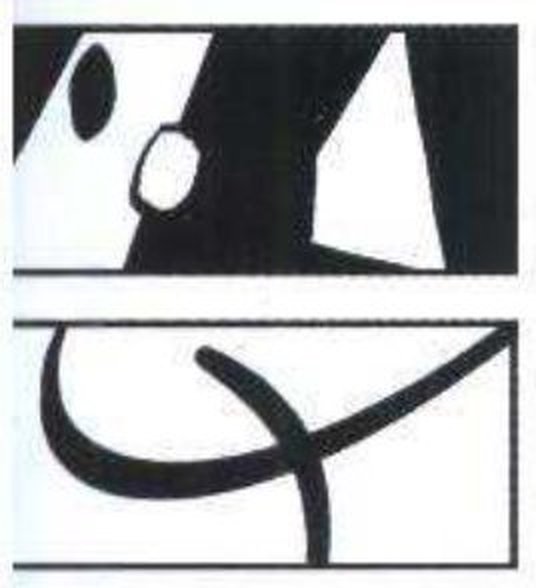
Most examples in FI1 chapter 3 come with two little thumbnails beside the finished image.
Mateu-Mestre · FI1 p.34“the first one shows the basic distribution of the light and dark masses”
The second shows the main lines of tension. On p.35 he describes it this way:
Mateu-Mestre · FI1 p.35“the dynamics of the image in terms of lines, whether physical or perceived”
Perceived lines are what he calls connecting the dots. On p.26 he lists what can make a line: a tree branch, a long piece of graffiti, a row of clouds, or the imaginary line that links characters’ heads.
One worked card
This is how a card works. Look at his finished image only. Make your two thumbnails. Then open his.
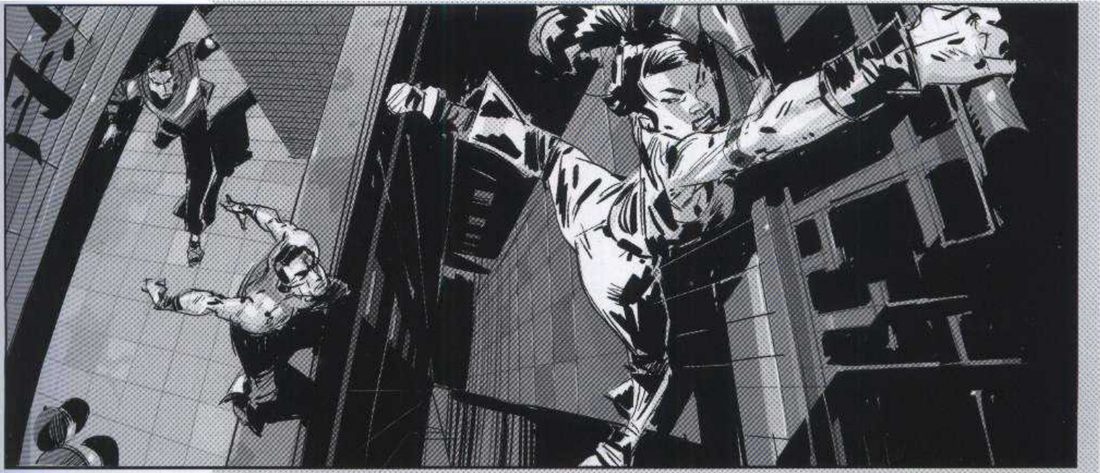
His version: open after you've done yours
The cards are on their own page. Each one shows his finished image with his thumbnails hidden until you reveal them.
When you practise
Read once
- Open a card. Look at his finished image only. Don’t read his paragraph yet.
- Write the one-line intent you read in it: what does this frame make you feel?
- Mass thumbnail: the light and dark shapes, black and white, small. His are about a quarter of the panel’s width on the page.
- Line thumbnail: the physical lines, then the connect-the-dots ones (heads, hands, a gun, a focal dot). Where do they point?
- Reveal his two. Put them beside yours. Note the biggest difference in each.
- Read his paragraph on that page if you want his reasons.
CheckHe states no check. Compare your two thumbnails with his. Then shrink and flip your mass thumbnail: does it still read as the intent you wrote?
Reverse-engineer
His image only → my two thumbnails → reveal his.
Keep asking: where do the lines point?
One emotion, one still
Build a single still frame to carry one specific emotion, planned in his order before you draw.
2012 mentoring plan (Motivarti) · FI1 p.11 (planning order), p.14 (six questions)
What he shows
In 2012 he wrote a plan for mentoring one student. The sessions would be built on Framed Ink. He would start with still shots, then move to continuity sequences where lighting and composition create moods, rhythms and emotions.
Mateu-Mestre · Motivarti mentorship page, 2012“represent / transmit specific emotions”
He gives no worked still for this, and no steps. The planning comes from FI1.
His order (p.11). Plan an image the way a book narrows down, from general to specific.
Mateu-Mestre · FI1 p.11“first we need to be clear about the general level of intensity”
- Intensity. The type and level of emotion driving the moment. His examples: extreme happiness, subdued sadness, explosive action.
- Specific action. What is happening and why. His example: sad because we miss somebody, or sad because we lost a winning lottery ticket.
- Style. Execution and style hold it together while supporting the story.
His six questions (p.14), paraphrased. He puts them ahead of art quality.
- What are we saying in the narration as a whole?
- What mood should the audience be in, across the story and at this shot?
- What is this moment’s function in the story?
- How will we take the audience there?
- What in the drawing contributes to the general statement?
- What can we leave out without changing what we’re saying?
When you practise
Read once · these steps are mine, built on his p.11 order and p.14 questions
- Write the one-line intent: what should this frame make you feel? Name one specific emotion.
- Write his three lines: intensity (type and level), the specific action and its cause, and the style.
- Answer the p.14 questions a single still can answer. One line each. Skip the rest.
- Mass thumbnail: light and dark shapes that carry the emotion, before any objects.
- Line thumbnail: the lines of tension. Where do they point, and what do they feel like?
- Fit the elements in and draw the still.
- Ask his question 6. Remove whatever can go without changing the emotion.
CheckHe states no check. Shrink and flip it: does it still read as the one emotion you wrote? There’s no key for this one.
One emotion, one still
Emotion → intensity, action, style → two thumbnails → the still.
Keep asking: what can I leave out without changing what it says?
Concept matching
Compose a set of scenes, one per abstract concept, clear enough that someone could match each panel to its concept from the list alone.
His reply to Jon by Instagram DM, July 2021 (paraphrased here, not reproduced) · Builds on FI1 p.11, p.14
What he says
Jon asked him how to practise the FI1 ideas so they become instinct, rather than copying his drawings with the same concept applied. This was his answer, and he called it a good starting point.
- Pick abstract concepts. His examples: relief, oppression, confusion, balance, frustration.
- Compose a scene for each. Scenes, with the concept carried by how the scene is built.
- The test. Show someone the drawings together with the list of concepts. Let them work out which panel goes with which concept, and see how successful you were.
- Repeat until your visual statements are clear.
He gives no number of concepts, no format and no timing.
When you practise
Read once · the order is his; the solo check in step 5 is mine
- Write the concept list. Use his five or choose your own. It’s the answer sheet, so keep it to one line each.
- For each concept, write a one-line intent: what should someone feel or read here?
- Make the two thumbnails for each one, value masses and lines of tension, before any subject matter.
- Build each scene on its thumbnails. Nothing in a panel names the concept: no captions, no labels, no lettering.
- Lay the panels out in a shuffled row and cover your list. Shrink and flip them. If two could swap concepts, push one until they separate.
CheckHis check is the matching: someone pairs each panel with a concept from the list, and the clearer your visual statements, the more pairs land. Solo, the session ends at step 5: no panel could be mistaken for another concept on the list.
Concept matching
A list of concepts → one scene each, no labels → could anyone match them?
Keep asking: is this a clear visual statement of that one concept?
Concept hunt
Pick one of his chapter 3 techniques, find it in an artwork or film still outside the books, and reduce that image to the two thumbnails.
Jon’s idea · techniques from FI1 ch.3, p.38–53 · precedent: Milena Milak, Chris Beaven
What he shows
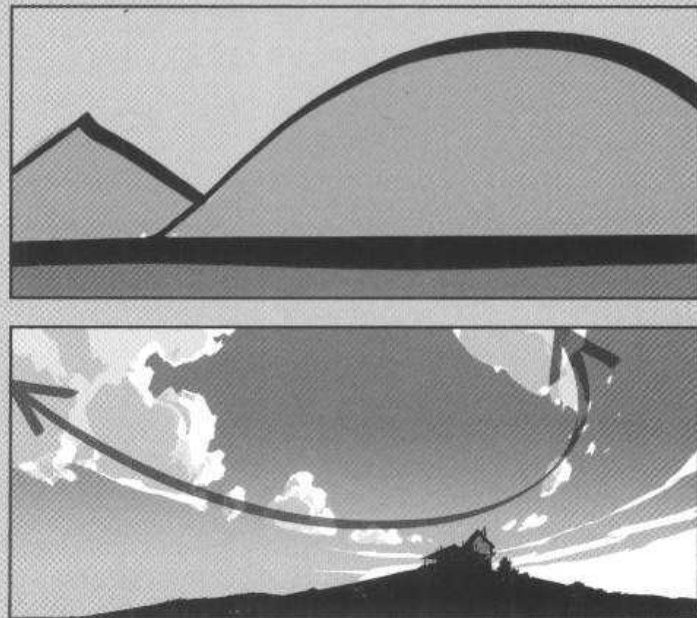
Each technique in chapter 3 gets a page of examples, most with the two thumbnails. He says the rules travel.
Mateu-Mestre · FI1 p.34“these can be applied to potentially any environment or situation”
Here is one technique, negative space, with his two thumbnails.
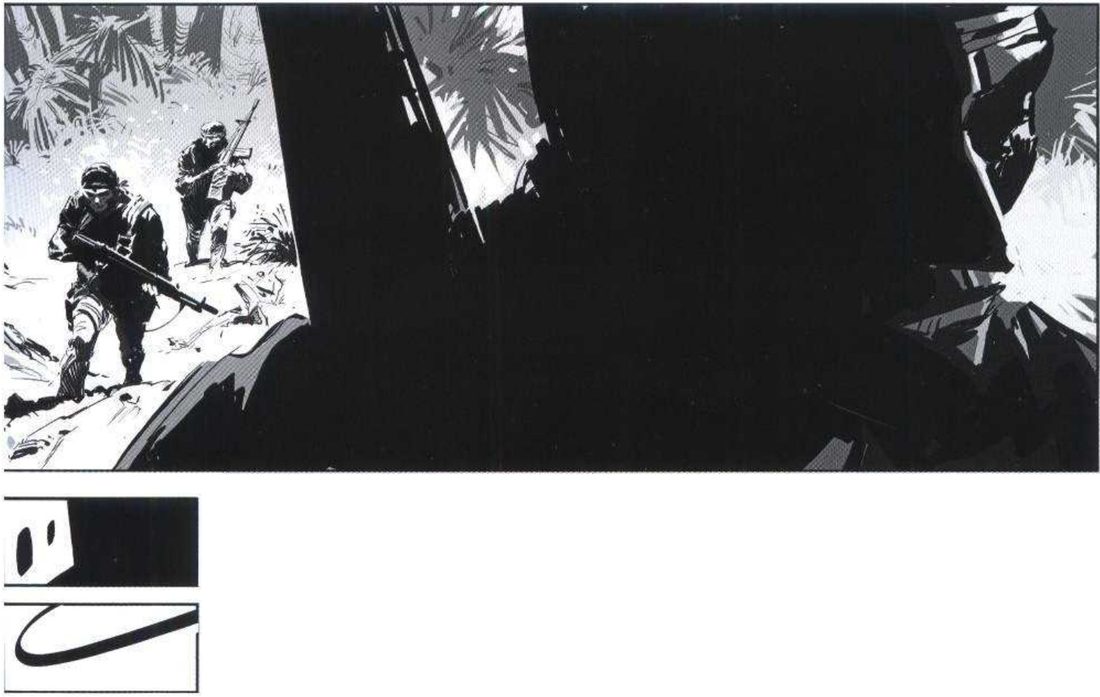
The menu
His chapter 3 techniques, with the page to reread.
- Establishing shots · p.38
- Animating the scene · p.39
- Looking down / overpowering upshots · p.40–41
- Negative space · p.42–43
- Order vs chaos · p.44
- Complex vs simple · p.45
- Big vs small · p.46
- Angular vs curved · p.47
- Tree vs forest · p.48
- Big, medium, small · p.49
- Landscape as a character · p.50
- Conceal and reveal · p.51
- Weird shots · p.52
- POV · p.53
Practitioner precedent
- Milena Milak sketches compositions from favourite films to understand why they work. For each still she asks: what makes it work, what does it say about the characters’ relationship, and what is the mood? (her post; it doesn’t mention Framed Ink.)
- Chris Beaven’s “100 Ideas for Daily Minimums” includes pausing a film for simple thumbnails (#53), sketching from stills of a film you love (#19), and a daily composition study from the best composers, with Framed Ink as the linked example (#30). (PDF; the PDF names no author.)
When you practise
Read once · these steps are mine
- Pick one technique from the menu. Reread his page for it.
- Find one artwork or film still, outside the books, that uses it. Spend no more than about 10 minutes choosing; the drawing is the exercise.
- Write the one-line intent: what does this frame make you feel?
- Write one line on where the technique sits in the image.
- Mass thumbnail, then line thumbnail.
- Glance at his thumbnails on that page to see the technique reduced. They’re a reference here. There’s no key.
CheckHe states no check; this exercise isn’t his. The check is: do your thumbnails show the named technique? Then shrink and flip them: do they still read as the intent you wrote?
Concept hunt
One technique → one outside image (10 min max) → two thumbnails.
Keep asking: do my thumbnails show the technique?